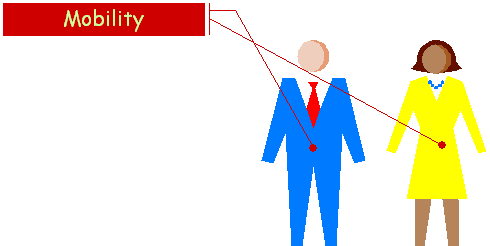
|
By: Michael Manion |
|
|
Page Views: 3,235 |
| All about your fourth System, Field and Inner Aspect. |
| Estimated reading time: 15 minute(s) (3507 words) |
About the Word

The flip side of the coin involves stillness. It is no great triumph for a tree to be still,
but for a Human stillness brings a special concentration to the movements that cannot be stilled:
The beating of the heart, the breathing of the lungs, the flowing of blood in the veins and arteries.
The trick is to find a balance in life between movement and stillness. Movement to bring us to the
experiences, stillness to savor and understand them.
Balance impacts the System of Mobility in another way, in that all ancient
studies of movement have found that effective, graceful movements rotate around
the body's center of gravity. That center is, of course, located beneath the
navel. Thoughts trigger movement, lead us to experiences, and are the result of
those experiences. Thus, thoughts—thinking—are also associated with the
System of Mobility.
At A Glance
| Location of Center |
Navel |
| Statement |
I THINK |
| Associated Field/Inner Aspect |
Mental |
| Interactions |
Balances, Coordinates |
| Tone |
D# |
| Color |
Orange |
| Chakra (for comparison) |
Second |
| Planetary Ruler |
Mercury |
Beneath the navel is the body's center of gravity. Graceful and effective motions
always rotate around this center. Awkward motions do not, although the compensation
for the awkward movement—if it doesn't end in a fall—ends with the body's
being in balance, after all. The trick is to understand and practice graceful, balanced
movements so that one is in control of one's motions.
Because movement brings experiences, and experience brings information, the statement of this System is I
THINK, associated with the Mental Field and Mental Inner Aspect.
The Importance of Mobility

Balance is a keyword associated with Mobility, because without it, there is no useful motion. With it,
you also find a balance between movement and stillness.
Movement brings you to experiences, stillness gives you time to ponder them; and
the experiences give you something to think about. Those thoughts then lead to further
movement.
Thought -> Movement -> Experience -> Stillness ->
Realization -> Thought is the circular path you follow throughout your life;
and it is the System of Mobility that paves that path.
I THINK

The active intelligence that creates statements of Mobility is in the form of I THINK.
I THINK comes in a variety of forms. I THINK statements are made which apply to
the Mental Inner Aspect, the Mental Field, and the System of Mobility. Inner Aspect
statements refer to the way the brain accesses or processes information; Field statements
refer to experiences and observed facts, and System statements motivate one to newer
experiences.
Please note the difference between I FEEL statements (third Field)
and I THINK (fourth Field) statements. I THINK refers to beliefs that have not been
experienced; I THINK refers to beliefs that have been experienced.
Facts
taught in schools or by teachers are mostly not directly experienced. One of the
confusions in this world is that such information, which is actually a belief, is
acted upon as experienced fact. It is a wise (and far more flexible) person who remembers
that handed-down information is, at most, a belief, and not a fact.
Examples
| Inner Aspect |
Field |
System |
| Your thought processes |
Your facts |
Your motivators |
| I THINK logically. |
I THINK that the Sun rises in the East. |
I THINK I need to see the dentist. |
| I THINK emotionally. |
I THINK that two plus two is four. |
I THINK I will go on a cruise. |
| I THINK haphazardly. |
I THINK that Mexico is south of the
United States.
|
I THINK I should take a bath. |
Why Aren't Experienced Facts Stated As I know
?
Primarily because your experiences are usually not subjected to rigorous proofs. You
may watch the Sun rise in the East each morning, but how East? Dead on, or
slightly to the north or south? Is there variation, day by day? And, while your
experience tells you that this has happened in the past, you don't really know
it will happen tomorrow—that's a belief.
Two plus two is not 4 in base two or base three.
And parts of Mexico lie farther north than parts of the United States.
Mental Inner Aspect
The fourth Inner Aspect is the Mental. This is implemented as the outer portions of
the brain.

The answer is simple. The brain does not, itself, hold anything. It is, rather, a
switching device that access information stored in the fourth energy field surrounding
the body. That field contains memories, experiences, encoded as field patterns. It is
the brain that provides access to that field.
The brain both places information into the field and reads what's already
there. How the brain does its job depends on the wiring of the neurons that make it up;
and studies have shown this wiring is affected by some experiences (especially
traumatic ones), and the way the brain is typically used. In other words, a musician
would typically be able to memorize a new melody more easily than someone who seldom
listens to music.
So, your experiences so far, including any injuries you may have suffered, the type
of books you read (or if you read), even the kind of work you do, contribute to the
structure of the brain and, therefore, the manner in which it stores and accesses
information.
Thus, people can say with some accuracy, "I THINK logically" or "I THINK
emotionally" or "I THINK better when I'm under pressure."
Exercise 4-a
Write down four Inner Aspect I THINK statements (referring to your thought
processes), Mark statements that indicate effective thinking with I+
.
Mark statements that indicate poor thinking with I-
. Neutral statements
may be left unmarked.
Unhealthy Inner Aspect
If you have an unhealthy third inner aspect, you have trouble storing or retrieving
information efficiently and accurately. Forgetfulness, inaccurate memory, and frequent
"Freudian slips" are all symptoms of fourth inner aspect problems. "I can't seem to
think straight" is what a person with these problems might say.
Energizing your Mental Inner Aspect
Get Enough Sleep

The fact is, most people have times when they "can't think straight", are muddled,
or can't focus mentally. Typically these experiences come when you haven't had enough
sleep, have had too much to drink, or are distracted by noise or other kinds of
stress.
So, to improve the health of your fourth Inner Aspect—the outer
brain—get enough sleep, avoid excessive drinking, and avoid stress.
One of the first thing experts will tell you about sleep is that there is no "magic
number of hours needed for adequate sleep." Not only do different age groups need
different amounts of sleep, but sleep requirements are also individual. Sleep
needs are just like any other characteristic you are born with, the amount of sleep you
need to function best may be different for you than for someone who is of the same age
and gender. Pertinent to you may be that you are absolutely at your best sleeping seven
hours a night, someone else may truly need nine hours to have a happy, productive
life.
This is so obvious that it is a wonder that anyone would have these problems. Yet,
many people go on missing sleep, partying, and tolerating enormous levels of
stress—in spite of the fact that, if you could think more clearly, you could
probably get our work done faster and so have more time to sleep; would therefore be
under less stress and therefore in need of less partying as a means of release.
The fact is, the effects of insufficient sleep, etc., are so pronounced, and
people think so ineffectively in such a condition, that it creates a vicious
circle: Not enough sleep causes poor thinking, which causes poor performance, which
causes lack of sleep, etc.
For example, insufficient sleep duration is linked with:
Increased risk of motor vehicle accidents
Increase in body mass index—a greater likelihood of
obesity due to an increased appetite caused by sleep deprivation
Increased risk of diabetes and heart problems
Increased risk for psychiatric conditions including
depression and substance abuse
Decreased ability to pay attention, react to signals or
remember new information
It won't get better until you finally put your foot down and make time for
that sleep that you individually need. Remember, to procure the right amount of sleep
you need for you. Once that is made up, you can expect your thinking to be back up to
speed.
Another aspect of this that is essential is making sure you are sleeping during the
times best for you. People travel all over the world today. Your own bio-rhythmus may
need to be sleeping at a place where the sun is still shinning and thus you are tired
more. Try resting during the time your body needs it most. This is some times called
jet lag. If you have lived your whole life in one area and move to another, your
internal clock may be off by hours and you need to pay attention to this so you are
getting sleep when you really need it.
A general rule of thumb is to note that as the day progresses the Human body begins
to want to relax. One peek for some is at 4 pm when the internal clock of many people
want to have a short break or rest. Don't force yourself to go full force at that time
if it comes up for you. Take the break! Another time to be aware of is as the sun is
setting energy levels are winding down after dinner whatever hour that might be for you
take a walk to unwind and then relax. from then on you will go through a cycle for a
need of deeper and deeper sleep until about 2 am when the body starts to cycle out of
it again and becomes more awake around sun rise.
These are natural body cycles and in the world today people have over ridden these
with working shifts during the darkest part of the night and sleeping during the day.
Caffeine and other substances are used to keep awake. Be aware that these take a toll
on the body and the brain. It is best to use natural substances that are not drugs or
powerful elements that can reek havoc on the nervous system as an over abundance of
caffeine can. Sleep aids such as valerian root, various herbs and tryptophan may be
better solutions. Then again when possible try abiding with the Earths rhythmus and
cycles and you can try to adjust to the natural sleep cycles that work best for
you.
Challenge the Mind

Since the brain is a dynamic organ whose structure is altered by the way it's used,
it makes sense to challenge the mind in order to make it more effective. Reading of any
sort improves the brain, but especially non-fiction and science fiction are useful.
Learning anything new strengthens the brain. Doing puzzles, especially of the
brain teaser sort, is also effective.
Avoid Aluminum

A connection has been shown between cooking with aluminum pots and pans, and the
later development of Alzheimer's disease. Certainly, the epidemic of Alzheimer's comes
forty years after the introduction of aluminum cookware and some researchers refute the
correlation. Most of what you don't need or want is to have any heavy metals leeching
into your food while it is cooking. Some cook ware does this even if it is not aluminum
anything you don't want in your food don't include! Find cookware that won't do
this.
As of this writing, there are some promising treatments on the horizon for
Alzheimer's, but none yet in place. Best shown results have been through proper diet
and proper mental and physical exercise. Your best bet to avoid it is to avoid the
cause. Cook in well coated iron, stainless steel, earthenware, or Teflon-coated
cookware that is not leeching into the food being cooked. Pitted or flaking coated pots
or pans may end up in your food. Cooking in glassware works really well such as Vision
Ware.
Mental Field
The fourth Field is the Mental. Since fields hold information in the form of
energy patterns, this field holds experiences. You can say "I THINK that…"
Part of learning to work with System Four is distinguishing between what you know
and what you believe. Many people think they "know" something (such as the superiority
of one of the political parties or religions, or the guilt or innocence of a celebrity
on trial) but, in fact, have not actually experienced these things. Beliefs are stored
in the Third Field; experiences, in the Fourth.
This is important to distinguish because beliefs are defended emotionally, while
experienced information is accessed rationally. As a Human, it is normal for you to
have to make decisions based on beliefs interacting with experience. You can do this
best when you know that the experiences you have had back up your rational or beliefs.
That may require some thinking about what you believe is true for you and see if it can
stand up to the test. In other words, are there others that agree with your thinking? Who disagree?
Note their agreements and objections and ultimately decide for yourself. The following
exercise may help.
Exercise 4-b
Write down four Field I THINK THAT statements (referring to your facts), Mark
statements that generally agree with "what everyone knows" with F+
. Mark
statements with which few people would agree, with F-
.
Unhealthy Field
If your memory of events is consistently at odds with the memories of others, this
is a sign of an unhealthy Mental Field. The problem is yours if everyone disagrees with
you; if only one person does, they have the problem (and the advice here is,
tape or video record all your dealings with them!).
You will also need to identify whether the problem is in the storage medium (the
Field) or the recording/access device (the Inner Aspect). Inner Aspect problems show up
immediately ("You said that a moment ago!" "I did not!") while Field problems tend to
affect older information more than recently-received information.
Energizing your Mental Field

Keep alert to memories you have of shared experiences, with which many others
disagree. Your recording may be faulty. On the other hand, suspect memories you have
that everyone seems to share—They may have been absorbed from TV or
movies.
Verifiable information, evidence, and experience are the keys to monitoring whether
your Mental Field recordings are accurate. If you find that others frequently or
consistently disagree with your memory of events, the wise course would be to consider
that the Mental Field is in need of strengthening..
Cultivate friends who will tell you honestly what their memory is of shared
experiences. One person remembering things differently is not significant, and it is
not uncommon for five witnesses to an auto accident to later describe five different
accidents. But if you have five friends who remember that you wore red that day, and
you remember wearing blue, it is likely that it is your memory that is faulty, rather
than all of theirs.
Mobility as a System
To the ancients, there were many principles of movement. The one that all others
seemed to follow was the concept of a center from which all other movement
radiated. When you contact this part of yourself, you can move in perfect harmony with
your own surroundings. In the Orient, specifically China and Japan, the concepts of
movement are taught in Tai-chi and marshal arts of all sorts. These people understand
that anyone who masters this art of movement is also a master of the craft of their
lives.
Traditionally, this center of balance is located in an area beneath the navel in the
Human body. When you allow yourself to experience moving from this area it may feel
strange at first. With practice, though, you find that this is the most efficient and
graceful way to move.
You have the ability to move yourself and the things around you so that you are in
harmony with your surroundings. When moving to the beat of a drum you can feel the
rhythm that attunes you to others. You are connected to others and all those things in
earshot of the beat by its rhythm and flow of sound and vibration. Similarly, you can
attune yourself to your own rhythm and that of your surroundings. Thus, you learn this
ability to move from a centered point within you that can harmonize with others and the
environment.
So what things get you moving? What gets you going and wanting to move? If you don't
follow through with something there may be a reason in your thinking process that you
have not examined. It begins with how you think about moving and how you move in
coordination with all things. In this next exercise lets look at how you think about
those things that first motivate you.
Exercise 4-b
Write down four System I THINK I statements (referring to your motivators), Mark
statements on which you are likely to follow through with S+
. Mark
statements with which you are unlikely to follow through, with S-
.
Unhealthy System
An unhealthy System of Mobility can be characterized by effects such as these:
Clumsiness
Broken bones, stubbed toes, bruises, cuts
Stated intentions are not followed by movement, or
Movement precedes intention
An unhealthy System of Mobility is indicated by a break or imbalance in the
Thought -> Movement -> Experience -> Stillness -> Realization ->
Thought cycle. Thus, intention ("I THINK I will take my bath now") is not followed
by appropriate action (the subject gets sidetracked and starts the laundry, or is
distracted by something on the TV as he or she passes by and stops to watch). This
hallmark of distraction leads inevitably to broken bones, stubbed toes, and all manner
of bruises since the mental is not focused on the intended experience.
Energizing your System of Mobility
To improve the health of your System of Mobility, you must learn and practice a
discipline that requires concentration and focus in regard to movement. There are
several such practices available.
T'ai Chi

Any of the martial arts will do, but
T'ai Chi was designed to be
a "moving meditation" and does not require great physical prowess to practice. It also
has the advantage of being non-confrontational. In this discipline, the practitioner
assumes certain balanced poses, and transforms them into other balanced poses.
Hindu Mudras, Belly Dancing, Hula Dancing
Mudra (English: ; Sanscrit: meaning "seal", "mark", or "gesture").
Some mudras involve the entire body, most are performed with the hands and fingers or
feet and toes. In , mudras
are used in conjunction with yogic breathing exercises. It can be correlated that
mudras stimulate and access the acupuncture energy meridians of the body and their
points. A brain research paper published in the National Academy of Sciences in
November 2009, demonstrated that hand gestures stimulate the same regions of the brain
as language. Each of these dance
techniques tells a story, requiring the practitioner to remember a fair amount of
information accurately.

Gymnastics
If you are already physically fit, or wish to be, gymnastics can strengthen your
System of Mobility and your physical body at the same time.
Ballroom Dancing
Also a good form of physical exercise, this method of strengthening the System of
Mobility works best for couples. This also assists in your ability to coordinate with
someone else in accomplishing movement goals.
Finding Your Mobility
Referring to the Systems chart in Workshop
Zero, please note that the parabolic plane for System Four extends from a center
located beneath the navel.